
5 signs your delivered catering process is creating unnecessary work
Delivered catering for meetings, events and booked hospitality spaces should be straightforward. But how much time is your team spending managing the process?
A customer orders delivered catering for a booked space, and the catering team prepares and delivers it to the right place at the right time.
But behind every order there can be amendments, cancellations, payment issues, customer communications and other details that need attention.
None of these tasks is particularly difficult on its own. But when they start to add up, they can create unnecessary administration and take valuable time away from the catering team.
Is your delivered catering process efficient?
Ask yourself these five questions.
1. Are your delivered catering orders coming through too many different channels?
Email, phone calls, spreadsheets and forms can all work individually.
The difficulty comes when your team has to combine them to understand what needs preparing, where it needs delivering and when.
If staff regularly check several places to understand the day’s orders, there may be an opportunity to simplify the process.
Bringing ordering into one central system gives customers a consistent way to place requests and gives the catering team one reliable view of what’s been ordered, what’s changed and what needs to happen next.
2. Is your team spending too much time searching for order information?
Where is the latest order? Has the attendee number changed? Did the customer reply? Was the dietary requirement added?
When information is spread across inboxes, spreadsheets and different people, valuable time can be spent finding information rather than acting on it.
Keeping order details, amendments and customer communications together means everyone works from the same information. It also makes it easier for another team member to pick up an order without searching through emails or asking colleagues for an update.
3. Do last-minute changes create unnecessary disruption for your team?
Changes are inevitable in delivered catering. Meetings move, numbers change and orders are amended or cancelled.
The question is whether your process makes those changes easy to identify.
Rather than relying on someone to spot an amended email or updated spreadsheet, look for a process that clearly highlights changes and anything requiring attention. This helps teams prioritise urgent work before a change becomes a service problem.
4. Is planning production harder than it should be?
Knowing what’s been ordered is only part of the job. Catering teams also need to know when demand is coming and where it needs to go.
If your team is working through individual orders to build a picture of the day ahead, planning can quickly become time-consuming.
A calendar or planning view of upcoming deliveries makes it easier to anticipate busy periods, plan kitchen production, allocate resources and organise deliveries – allowing the team to prepare for demand rather than react to it.
5. Do you have enough visibility across all of your delivered catering sites?
Managing delivered catering becomes more complex when you introduce different rooms, buildings, kitchens or sites – along with ordering cut-offs, lead times and different product availability.
If these rules are being checked manually, or managers don’t have one clear view across the operation, unnecessary work can quickly build up.
Centralising the operation and building rules into the ordering process can reduce manual checks and help prevent unsuitable orders from being placed. It also gives managers greater visibility of demand and what needs attention across different locations.
Delivered catering doesn’t have to be this hard.
If several of these questions sound familiar, it may be time to look at how your delivered catering operation is managed.
Uniwares Ordeli solution brings customer ordering together with the operational tools catering teams need to manage orders, changes, communications, planning and availability.
A single operational dashboard – showing order status, so teams can immediately see what needs action.
Real-time visibility – see all amendments and cancellations, helping teams prioritise urgent work before it becomes a service issue.
Payment failure notifications – charge status visibility enables finance teams to resolve issues before delivery.
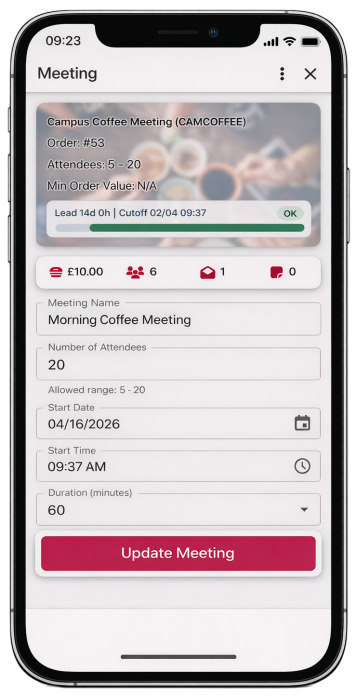
Rules based ordering – set option rules by room, date, meeting type and set minimum lead times, reducing orders that cannot be fulfilled.
Spend less time managing the process and more time delivering great service.
Recognise some of these challenges?
Discover how Ordeli simplifies your delivered catering operation, reduce administration and give your team greater control.